


Local Denizens of the Leaf Pile

By Jami Blaauw-Hara
Spring landscapers are out at many condominium complexes and buildings as they blow leaves and pull away fallen limbs. It’s bustling work and accepted as basic maintenance for many homeowners, but at Blooming Boulevards, we know that clearing away leaves and twigs too early disrupts pollinators who rely on fall detritus for nesting and laying eggs. If you allow leaves to remain in place until the days are consistently 10 degrees or more, you will protect habitat for the following spring-time creatures, some of which are all-star pollinators:
Eastern tiger swallowtail (Papilo glaucus)
These butterflies emerge in early April and spend the season feasting on flowers like purple coneflower (Echinacea purpurea), wild bergamot (Monarda fistulosa), and most milkweeds (Ascelpias ssp.). The chrysalises look like dried leaves on stems or litter, so they are easy to miss or disturb among the dried bedding.

Mourning cloak (Nymphalis antiopa)
With a lifespan of 11 to 12 months, these are some of the longest-lived butterflies. Adult butterflies hibernate during the winter months in tree cavities or on the ground under loose bark covered in snow. They emerge from hibernation before the snow melts, making them one of the first butterflies you will see.

Eastern comma (Polygonia comma)
This butterfly does not pollinate flowers but instead feeds on sap, rotting fruits, salts, and minerals. The adults use dead-leaf camouflage to hide during winter and hibernate.

North American luna moth (Actias luna)
These large moths (8-11.5 cm wingspan) spin their cocoons with silk and leaves to pupate on the ground over the winter. They emerge in late May or early June in Ontario. While they don’t pollinate, they live on the fat stores they developed as caterpillars, feeding on the leaves of hardwood trees like walnut, hickory, and paper birch. Their elongated tails are thought to confuse the echolocation of predatory bats.

Common eastern bumble bee (Bombus impatiens)
In the fall, queen bumblebees burrow into already existing cavities in brush and the soil. They rely on the leaf layer to keep their burrow safe from freezing temperatures. When they emerge in the spring, they spend a few weeks feeding on the earliest spring flowers while they look for a good location for a nest.

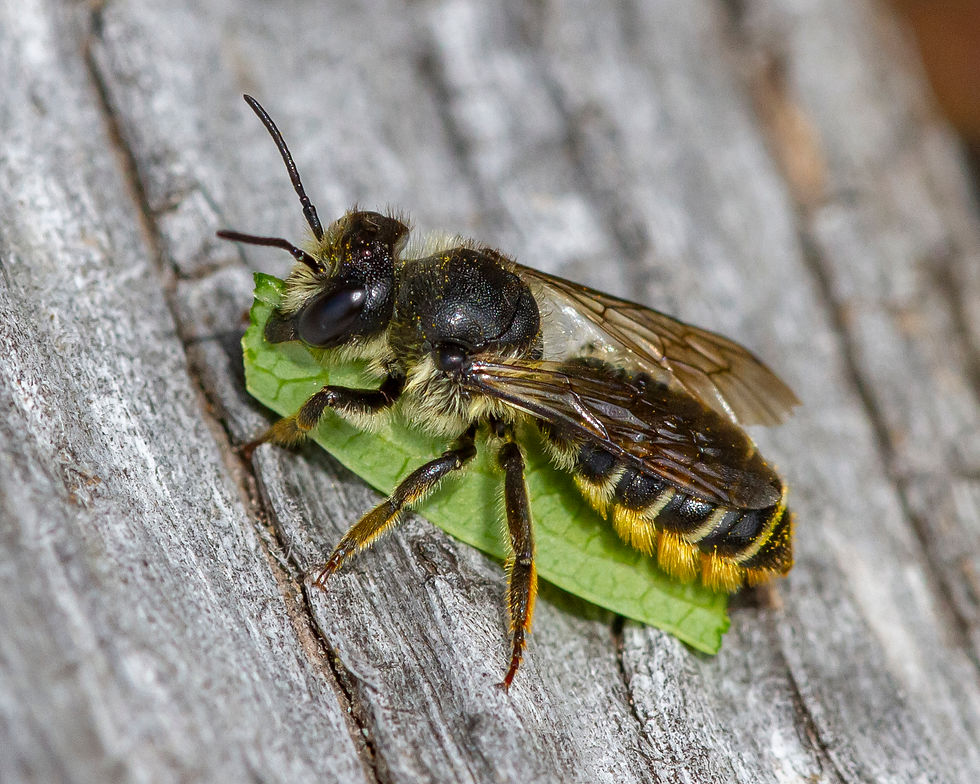
Golden-tailed leafcutter bees (Megachile relativa)
These bees overwinter in leaf debris as dormant, mature larvae. When it’s warm enough, they finish their maturing and emerge as new adults. The females find cavities to lay their eggs, surrounding them with pollen loaves gathered from a variety of flowers. The pollen loaves feed the larvae when they emerge, and she will use leaves from soft, thin-leaved plants like tick trefoil to build and seal her nest.
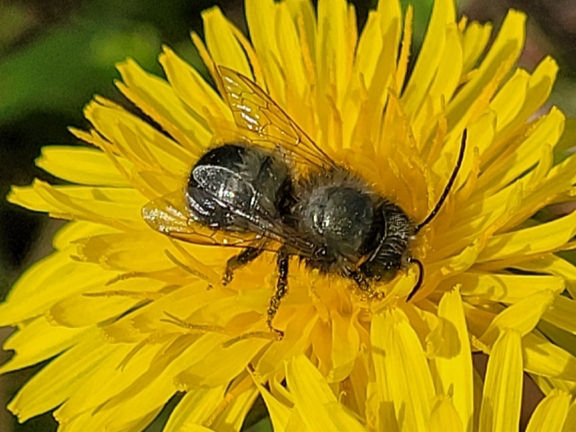
Blue orchard bee (Osmia lignaria)
These gentle mason bees emerge from their cocoons in the spring and are some of the best pollinators of early spring flowers. They nest in narrow holes or tubes, which can include downed branches and trees.
If their cocoons are disturbed or they are cold for too long, they burn through their fat reserves and die. If the temperature rises too quickly, they can emerge when pollen is scarce or when the weather can return to very cold temperatures.
This native species is being threatened by invading Asian mason bees brought to the US as pollinators more than 50 years ago. One of the vectors for this invasion could be bee hotels that well-meaning property owners purchase to support cavity-nesting bees like the blue orchard bee. Entomologists have been surveying bee populations for decades and only recently have seen an uptick in invasive species.
For gardeners, it’s important to avoid buying bee cocoons online because many are not native mason bees and will crowd out all other competitors. The best way to protect native bees? According to Professor Scott MacIvor at the University of Toronto, it’s building gardens with native flowering plants and protecting spots where nests develop naturally. Source: https://www.utoronto.ca/news/non-native-bees-discovered-canada-may-pose-serious-threat-native-mason-bee-populations
As Laura Timms says, "Don’t feel guilty about taking the task of raking the leaves off your to-do list! You’re not being lazy – you’re being a good friend to the insects we need in the environment."
Resources
Learn more about how insects use leaves for food and shelter through the Leave the Leaves campaign, developed by Xerces Society – a science-based nonprofit organization that protects wildlife through the conservation of invertebrates and their habitat.
Learn about other butterflies and beneficial beetles in Winter Habitat and Protection Among Leaf Litter by Laura Timms, Senior Specialist, Natural Heritage Management, Credit Valley Conservation
---


Comments