


Common Types of Ontario Milkweeds

By Lia Vn Balen
Milkweed Characteristics
Milkweed is famous for its distinct seeds. Thick pods contain brown oval seeds attached to a fluffy "pappus" (or silk) that catches the wind like dandelion seeds, riding the air to new growing sites.
When growing milkweed seeds, they need to be cold stratified – kept moist and cold in your fridge for 60 days to mimic Ontario's winter and trigger sprouting.
Some species spread locally through rhizomes, sending up new shoots and creating a dense colony. Other species, like common milkweed (Asclepias syriaca), have a fleshy taproot that grows several feet deep into the ground. Established plants are drought-tolerant but don't typically survive being moved.
The term "milk" refers to the thick milky latex the stem and leaves produce when broken. This sap contains cardiac glycosides, toxins the plant uses to protect itself.
As a safety precaution, you may wish to wear gloves when working around milkweed. The latex can irritate the eyes and should not be ingested.
Indigenous peoples have traditionally consumed the young shoots, as well as the unopened flower buds and young, firm pods later into the summer. Additionally, the stem's strong, hemp-like fibres have a long history of being used to create high-quality cordage, such as ropes and bowstrings.
Monarch Butterflies
© MISteward, some rights reserved (CC BY-NC). iNaturalist. / © Ruben De La Rosa, some rights reserved (CC BY-NC). iNaturalist.
Our famous monarch butterflies migrate from their overwintering sites in central Mexico and the southern US, arriving here in late May or early June and departing again in late September. Milkweed is so critical to their survival because it's the only plant that monarch caterpillars will eat, and is an important nectar source for adult butterflies.
As mentioned earlier, milkweed is toxic to many other animals. Monarch caterpillars ingest these chemicals, holding the toxins in their bodies to make themselves foul-tasting to potential predators — even as fully fledged butterflies.
Ontario is home to 20% of Canada's monarch population. Sadly, the species is under threat and numbers have declined over the last several decades because of habitat loss, fewer wildflowers, parasites, and pesticides.
How you can help
To restore populations, there are a few things you can do:
Find a patch of milkweed and check plants for any eggs or caterpillars four times over the course of the summer (ideally every week) and submit your findings to Mission Monarch. This is a community science program run by Insectarium – Montréal Space for Life and the Institut de recherche en biologie végétale in Quebec.
Turn your garden into a monarch oasis by growing your own milkweed patch. A 2018 Iowa State University study found that monarchs prefer to lay eggs on common milkweed and swamp milkweed.
You can purchase milkweed seedlings at Blooming Boulevard's annual plant sale on May 30 and 31 and at local native plant nurseries.
You can often find free seeds through your local library's seed bank exchange program, but make sure they are native to the region.
Ontario Milkweeds
While there are 12 species of milkweed in Ontario, you're most likely to encounter these four.
Swamp Milkweed (Asclepias incarnata)

© markk178, some rights reserved (CC BY-NC). iNaturalist.
Don't be fooled by its swampy, weedy name. Swamp milkweed (Asclepias incarnata) is a gorgeous, tall flowering native perennial that buzzes with pollinators. It can grow up to 1.5 metres tall and has clusters with multiple stems. Its fragrant pink blossoms attract butterflies, bees, and hummingbirds, blooming for four weeks in mid- to late summer.
It's often confused with common milkweed, though it has shorter, narrower, and more pointed leaves.
As the name suggests, it's at home in regular to wet soil, making it a towering wonder not only in a rain garden but also in any garden where it can be watered consistently. It doesn't do well in hot and dry locations. In the wild, it's found in full sun or partial shade along waterways, swamps, and drainage ditches.
It tends to stay where it's planted, in contrast to the related common milkweed (Asclepias syriaca), which has a reputation for spreading throughout the garden.
Common Milkweed (Asclepias syriaca)
© sheilaknell, some rights reserved (CC BY-NC). iNaturalist.
Over the last few decades, farmers’ and gardeners' relationship with common milkweed has evolved. Livestock can suffer from milkweed poisoning if they eat it — a greater risk if the plant has been dried into hay, which maintains the toxins and loses the bitter taste that normally keeps cattle and horses from avoiding it. Before the advent of modern pesticides and agriculture management, milkweed's deep root system could out-compete grain crops, significantly lowering farming yields.
In 2014, the Ontario Ministry of Agriculture, Food and Rural Affairs (OMAFRA) removed common milkweed from the Noxious Weed list (which currently includes such horrors as Japanese knotweed, kudzu, Wild Parsnip, and poison ivy), meaning municipal weed inspectors could no longer force landowners to destroy milkweed on their property.
Of all the species, it is the most aggressive spreader, but that doesn't mean it's uncontrollable. Plant it somewhere it has lots of space and you'll get a thick patch going in a few years. I have mine secured between my driveway and a retaining wall, so it can't escape into other garden beds. It sends out horizontal runners a few inches under the soil, so you'll get some popping up a few feet away from where you planted the original.
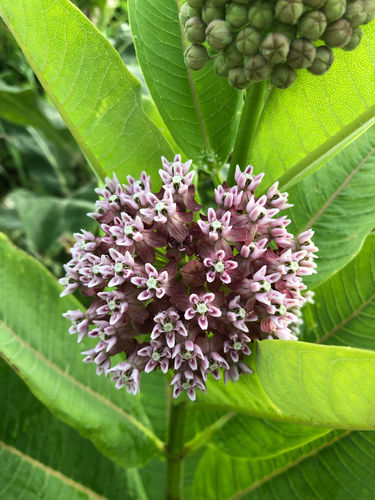
Its umbel (umbrella-like cluster of flowers) ranges from white to pale pinkish-purple. They are sweet-smelling — reminding me of vanilla, or reminiscent of vintage floral perfumes. It grows up to 2.5 m tall and will bloom for up to 6 weeks from early to mid-summer. It prefers sunny locations and tolerates drier conditions than swamp milkweed. In the wild, it thrives in roadside ditches and meadows.
I tried growing mine from seed two ways: planting directly in the ground in the fall versus cold stratifying in the fridge before sprouting in seedling trays. It definitely does not enjoy being moved as a seedling — it grew taller and faster when planted directly in the earth. It also takes two years to bloom, as it spends most of its first year growing taproots 2 to 3 metres deep.
After two years of planting milkweed in my garden, I'm starting to see monarch butterflies, but no caterpillars as of yet. Fingers crossed for this year.
Butterfly Weed (Asclepias tuberosa)

© jonahbt, some rights reserved (CC BY-NC). iNaturalist.
When hunting for milkweed, I saw this labelled in nurseries simply as "Butterfly Weed." It has vibrant orange flowers, is shorter — about a metre tall — with narrower leaves and grows in rounded clumps. This threw me off, and I didn't realise it was another species of milkweed until later.
After seeing my common milkweed spread, I was concerned I was in for a containment battle. However, butterfly weed is more well-behaved and doesn't spread by rhizomes.
It lacks the milky latex sap other species have, which is why it's commonly called weed instead of milkweed.
It's uncommon in the wild. It prefers gravelly or sandy soils and dry, sunny conditions.
Poke Milkweed (Asclepias exaltata)

© doug_mcgrady, some rights reserved (CC BY-NC). iNaturalist.
I was excited to learn about this species, because it's one of the few shade-loving milkweeds. Poke milkweed grows in open woodlands, forest edges and shaded roadsides. It prefers moist conditions with partial sun exposure, and rich loam or sandy soil.
It has petite, white to light purple flowers that droop down, with fewer blooms per umbel than common milkweed. It reminds me of nodding onion. It blooms between June and August and has a stronger fragrance than other milkweeds.
It's recommended to plant it in a protected area, as it can be damaged by strong winds.
Sources
Lady Bird Johnson Wildflower Center: Asclepias incarnata (Swamp Milkweed)
Royal Botanical Gardens: Growing Milkweed in Ontario
Ontario Nature: Monarch Butterflies and How You Can Help
NatureWatch: MilkweedWatch
Canadian Wildlife Federation: Milkweed Species of Canada
Ontario Wildflowers: Common Milkweed (Asclepias syriaca)
Ontario Wildflowers: Swamp Milkweed (Asclepias incarnata)
Master Gardeners of 1000 Islands: Ontario Milkweeds
Watersheds Canada (The Natural Edge): Poke Milkweed
Xerces Society for Invertebrate Conservation: Are Milkweeds Really Weeds?


Comments